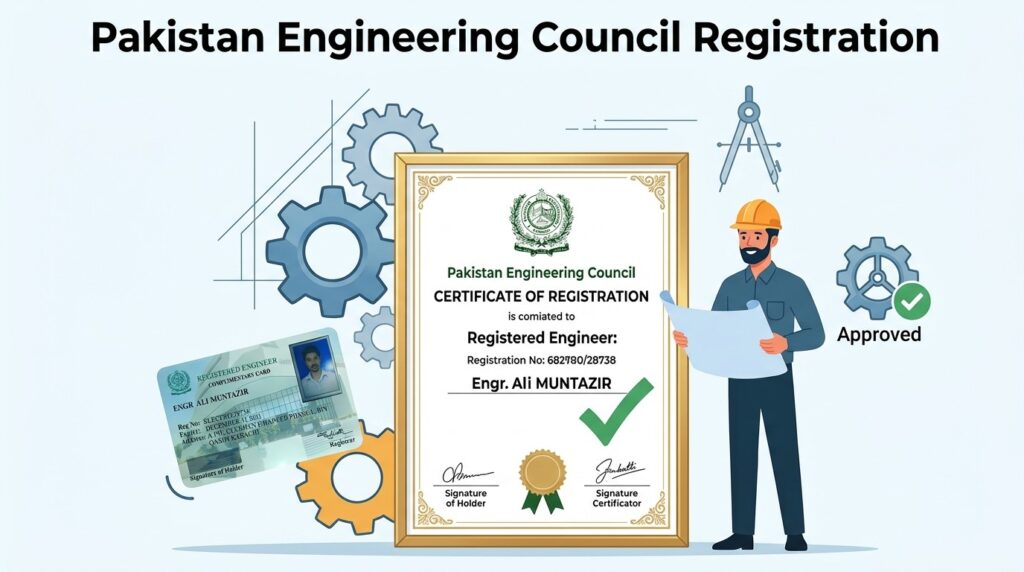
PEC Registration — Regulatory Foundation and Business Opportunity
Research Market: Pakistan · Focus: individual registration, legal framework, and the foundation for a registration consultancy business.
1. PEC and its regulatory role
Pakistan Engineering Council headquarters, Islamabad. Official PEC image.
PEC emblem, representing the national engineering regulatory body.
The Pakistan Engineering Council (PEC) is the statutory body responsible for regulating the engineering profession in Pakistan. Its legal foundation is the Pakistan Engineering Council Act, 1975, published as Act No. V of 1976. Its responsibilities include maintaining registers of qualified engineers and relevant engineering firms, accrediting engineering qualifications, and regulating professional engineering practice.
PEC
+1
This matters to our business research because PEC registration is not simply a generic government form-filling exercise. Applicants must satisfy the relevant eligibility requirements, and the Council—not a private consultant—determines whether those requirements have been met.
1.1 The three distinct registration markets
The first major finding is that the research must distinguish three different customer needs.
Individual engineer registration
An engineering graduate applies for personal professional registration, generally beginning with Registered Engineer (RE) status if eligible. This is the most straightforward starting point for investigating a high-volume, entry-level assistance service.
Consulting engineer or engineering consultancy firm
A person or firm providing regulated engineering consultancy services, such as technical studies, designs, reports, or engineering supervision, falls into a different regulatory category. Applicable registration requirements must be checked separately.
Constructor and operator licensing
Engineering and construction businesses may need a relevant PEC firm licence, depending on the work they undertake. Categories, staffing, qualifications, experience and fees can differ substantially from personal engineer registration.
These distinctions are grounded in PEC’s statutory framework and its separate registration systems for engineers, consulting engineers, constructors and operators.
PEC
+2
For our initial business model, individual registration assistance should be the first service examined. Firm licensing should be researched as a separate, potentially more complex service line.
2. The legal foundation: what the law actually regulates
The PEC Act establishes the authority to register engineers and regulate professional engineering activities. It distinguishes a Registered Engineer from a Professional Engineer and separately defines consulting engineers, constructors and operators.
PEC
An important statutory distinction is that the Act defines a Registered Engineer as someone with an accredited engineering qualification who is registered with the Council. It further states:
“Registered Engineer shall perform all professional engineering works except independently signing design.”
PEC
This is a short quotation from the statutory definition, not a substitute for reading the applicable Act, amendments and regulations.
2.1 What this means for a registration consultancy
The business providing application assistance and the business providing engineering consultancy must not automatically be treated as the same thing.
A company that helps applicants organize documents, understand application instructions, and navigate an online registration portal is offering administrative assistance. A company that independently performs regulated engineering consultancy work may face a different set of professional registration and licensing obligations.
The exact boundary—and whether a particular assistance business needs any specific registration or permission—requires a separate legal assessment of its activities. It would be premature to claim that every registration assistance company must itself hold an engineering consultancy licence, or that every such company is automatically exempt.
PEC
+1
For our business analysis, this creates an important distinction between legitimate administrative assistance and claims of official authority.
3. Individual registration: eligibility and professional categories
The first distinction to establish is whether an applicant needs basic engineer registration or is seeking recognition at a higher professional level.
3.1 Registered Engineer (RE)
The general route is for a graduate who holds a qualifying engineering degree from an appropriately accredited programme. Qualification recognition is central: a degree title or university name alone should not be treated as conclusive evidence of eligibility.
There is a discrepancy in the official guidance reviewed. The online registration portal refers to eligible graduates after April 2005, while the detailed RE guidelines refer to graduates after 15 January 2008. This should be resolved with the Council for applicants whose graduation dates or qualifications fall around the relevant periods. We should not build a consultant’s eligibility advice around an unverified cutoff.
PEC PORTAL
+1
Fresh graduates also have a specific route. The portal directs graduates from intake Batch-2021 onward to contact their higher education institutions for processing through the integrated Pathway to Practice system. This means some graduates may not need to follow the same independent application route as older applicants.
PEC PORTAL
3.2 Professional Engineer (PE)
Professional Engineer status is a separate category, with additional professional competency requirements.
The general statutory definition includes an accredited engineering qualification, five years of professional experience, and passing the prescribed Engineering Practice Examination (EPE). The detailed PEC guidance also provides different routes for certain older graduates and internationally recognized professional titles.
PEC
+1
Applicant category
General route
Eligible engineering graduate
Apply for RE registration through the applicable portal or institutional pathway
Existing RE seeking PE status
Satisfy the applicable experience, examination and professional development requirements
Certain graduates from older cohorts
Check eligibility for the assessment/interview route
Foreign-qualified engineer
Verify qualification recognition and the applicable registration category
Engineering business
Determine whether it needs consulting engineer registration or a constructor/operator licence
This distinction has direct business implications: basic RE applications, PE applications and engineering firm licences should not be sold as interchangeable services or priced as if they require the same work.
4. Required documents and application preparation
For a straightforward individual RE application, the online instructions identify the following core documentation.
Initial document checklist
Engineering degree certificate or applicable academic testimonialsAcademic transcriptCNIC details and readable scanned copyApplicant signatureRecent photograph with blue backgroundRegistration fee payment receipt, when a fee is payableAny additional documents requested for qualification verification
0 of 7 checklist items marked
The current online guidance recommends readable scanned files and provides a maximum file size of 1 MB. It also states that the photograph supplied is used on the registration certificate. Applicants should check the current portal instructions before uploading because requirements and technical specifications can change.
PEC PORTAL
+1
PE applications require additional material depending on the applicant’s eligibility route. The published guidance identifies items including experience sheets, evidence of examination results where applicable, professional development records and, for certain routes, employer experience certificates and a self-assessment report. Assessment or interview may also be required.
PEC
The most important preparation risk
The RE guidance warns applicants to provide correct information because data may not be amendable after submission. This gives applicants a practical reason to check personal details, degree records, qualification recognition and the selected category before submitting the application.
PEC
For a legitimate consultancy, a documented pre-submission review could therefore be more valuable than simply charging someone to upload files.
5. Registration process: the applicant’s route
01
Identify the correct category
Determine whether the applicant needs RE registration, a PE upgrade or another type of registration.
02
Verify qualification eligibility
Check the engineering programme, graduation cohort and applicable recognition requirements.
03
Choose the appropriate application route
Eligible recent cohorts should check the institutional Pathway to Practice route; other applicants should consult the standard registration portal.
04
Prepare and upload documents
Check names, degree details, scans, signature, photograph and all supporting documents.
05
Pay the applicable official fee
Confirm the fee shown for the actual application type and retain the payment acknowledgement.
06
Submit and monitor the application
Follow the application status and respond to requests for additional information or verification.
07
Confirm registration and validity
Verify the resulting registration record and understand any applicable renewal requirements.
The application is governed by the applicable official registration process; an intermediary’s participation does not itself confer authority to approve a registration. The official portal also provides account assistance, application guidance, registration-number verification and complaint facilities.
PEC PORTAL
+2
6. Official fees and the initial cost baseline
The published fee schedule gives the following figures for individual engineer registration.
Registration service
Published fee
New RE registration
PKR 1,000
Professional Engineer (PE) title
PKR 5,500
Duplicate registration certificate
PKR 1,000
Change or correction to registration details
PKR 1,000
These amounts are taken from the published fee schedule and relevant professional registration guidance.
PEC
+1
There is an important qualification: the registration portal says that graduates of the current or previous year may receive complimentary registration and separately mentions PKR 1,000 for a lifetime subscription option. Therefore, applicants should verify the amount shown for their particular category and subscription choice before payment. The published figures should not be presented as a universal final cost for every applicant.
PEC PORTAL
+1
The total cost of hiring a consultant would be different. It may consist of the official fee, any applicable verification or document expenses, and the consultant’s service charge. The consultant’s fee is not an official PEC fee.
For our business research, this distinction will be essential when comparing self-registration with paid assistance.
7. How long does registration take?
The official material reviewed establishes the application pathways and documents but does not provide a single, clearly applicable current processing-time commitment for every type of individual RE application.
Consequently, we should not claim that all registrations take a fixed number of days.
A reliable turnaround-time analysis needs to distinguish:
Straightforward applications with complete documents.
Applications requiring clarification or academic verification.
Foreign-qualification applications.
Older-cohort cases or applications involving assessment and interviews.
PE applications, which have additional professional competency requirements.
A consultancy can potentially reduce avoidable delays by improving document preparation and follow-up. However, there is no evidence in the reviewed material that paying a consultant automatically makes PEC approve an application faster.
This question will require further research using official service commitments, dated customer experiences and any verifiable processing records.
8. What Phase 1 tells us about the business opportunity
The preliminary research supports a potentially viable administrative assistance service, but it does not yet establish how profitable that service is or whether a particular consultant can be trusted.
The key commercial observations are as follows.
8.1 The basic application process is accessible
PEC provides an online route for registration, published instructions and supporting account services. Applicants can therefore attempt registration themselves; consultancy should not be marketed as compulsory without evidence.
PEC PORTAL
+1
8.2 The value must come from reducing difficulty
A basic service that merely uploads documents may offer limited differentiation. More useful services could include eligibility screening, document quality checks, application preparation, guidance on objections, and assistance with more complicated cases.
These are potential service opportunities, not yet proven market-demand findings.
8.3 More complex services should be assessed separately
PE applications have additional requirements, while consulting engineer firms and constructor/operator businesses operate under their own regulatory arrangements. These may create opportunities for higher-value assistance, but each service needs its own eligibility, effort and pricing analysis.
8.4 Credibility will be a central commercial issue
A consultancy should clearly identify itself as an independent service provider, distinguish its own charge from official fees, provide written terms and avoid promising guaranteed approval. Claims of official affiliation or privileged access must be independently verified.
The next research phase should investigate existing providers, the services they actually sell, their publicly quoted prices, customer reviews and evidence of completed cases. Without that work, it would be premature to label the market profitable or a particular provider reliable.
9. Phase 1 findings: confirmed facts and open questions
Research question
Initial finding
Status
Is PEC a statutory regulator?
Yes; its authority is grounded in legislation.
Established
Are RE, PE and firm licensing the same?
No; they are distinct regulatory categories.
Established
Can applicants apply online?
Yes, subject to the applicable application pathway.
Established
Is a consultant mandatory?
The official material reviewed does not establish a universal requirement to hire one.
Initial finding
What are the published individual registration fees?
RE: PKR 1,000; PE: PKR 5,500, subject to category-specific rules and concessions.
Published figures; confirm at application
Is there one universal processing time?
No universal current commitment was established in the material reviewed.
Further research required
How much do private consultants charge?
Not yet established.
Market research required
Are current providers reliable?
No provider-level reliability assessment has been completed yet.
Market research required
Is the consultancy business profitable?
Not established by official registration rules or fees alone.
Financial research required
10. Recommended direction for the next phase
The next phase should concentrate on the practical applicant journey and the market for registration assistance: precisely which applicants qualify, which documents each route requires, where applications commonly become difficult, and what support PEC actually permits or expects when another person assists an applicant.
After that, the commercial research can identify actual consultants and companies in Pakistan, investigate their prices and reputations, compare DIY costs with their packages, and develop realistic startup and earnings scenarios.
The central conclusion from Phase 1 is that the opportunity should be evaluated as a business that helps people navigate a regulated process—not as a business that sells registration approval.
PEC Registration — Regulatory Foundation and Business Opportunity Research Market: Pakistan · Focus: individual registration, legal framework, and the foundation for a registration consultancy business.
SECP research series — Phase 4. This phase examines who can participate in incorporating a company in Pakistan and what information or documents applicants must
Pakistan’s SECP-administered Framework to Register Business and Organization This phase identifies the legal forms through which businesses and other organizations can be established or registered
Phase 2 of the SECP research series. This article examines the legal foundation behind what is commonly described as “SECP registration” in Pakistan. The purpose
What Does “SECP Registration” Actually Mean in Pakistan? The phrase “SECP registration” is widely used in Pakistan, but it does not describe one single legal